Showing posts with label Flowers. Show all posts

Wednesday, 3 May 2023

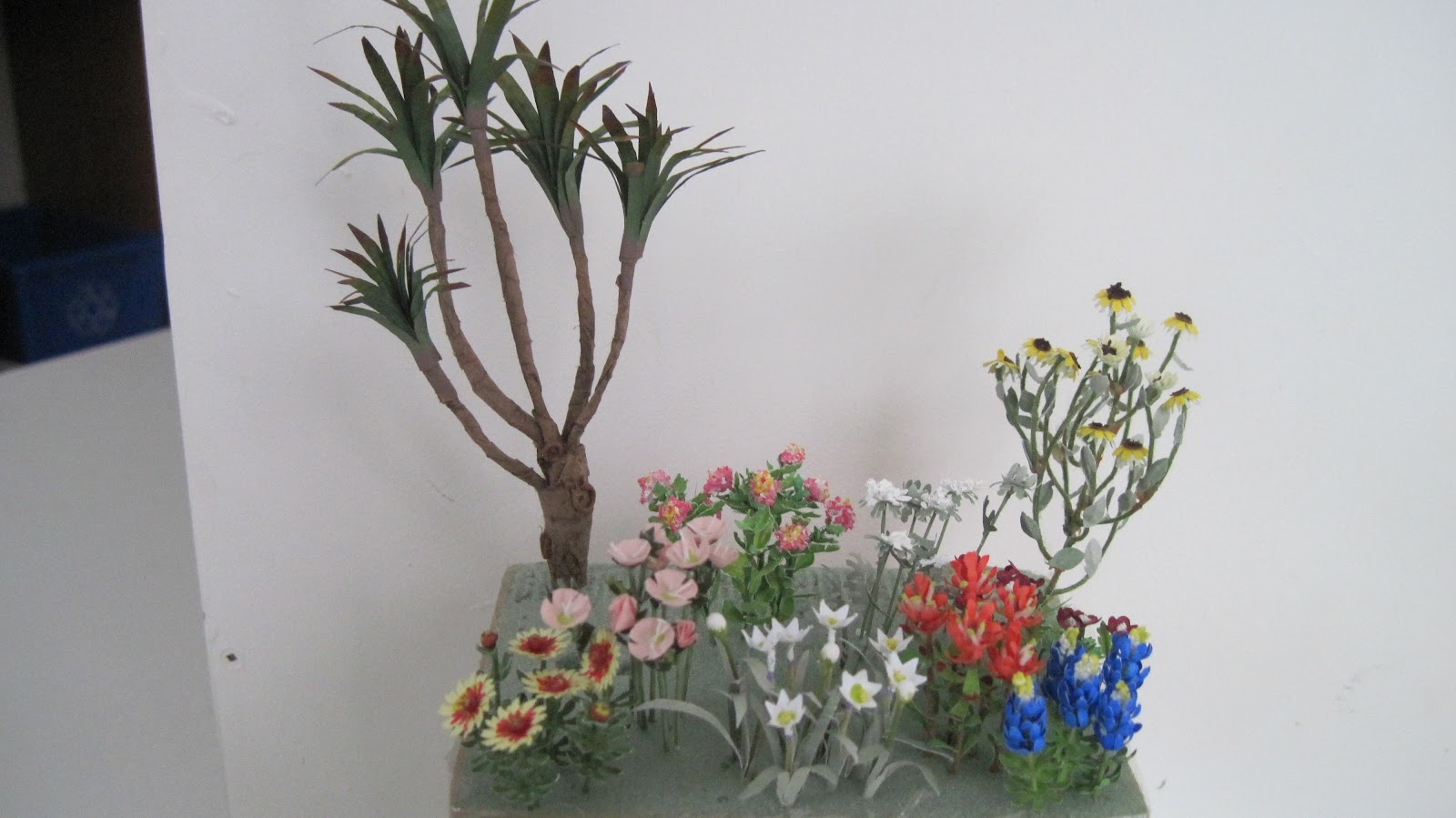
Well, At Least the Desert Garden is Done


 I'm very happy with the way this little dry garden turned out; all the plants in it are the kind that require only minimal water, so they are ideal for dry conditions. The colours work well together, and if I have the energy I may add a little morning glory to one of the fence posts once the show is over.

The display I tried to make for the wooden furnishings fell to pieces, because I was using cheap dollar store foam core; I'm not sure of the best way to display the almost weightless pieces, but perhaps a glass base will be the best one. And the niches in my wonderful printer's tray are too narrow for most of the plants I'd hoped to display and exhibit. I've literally run out of time. You can perhaps tell  that I'm not too happy with myself right now.

Pricing and packaging will take me much of tomorrow afternoon; in the morning I'm expected at two back-to-back work meetings. I will have a little time Friday morning, but I have to pick up my passenger in time for the two of us to get to the show location by 3 p.m. - the drive is about 2 hours. Friday afternoon and evening will be occupied with setting up for the show. I'm hoping to borrow some boxes from work to carry the display pieces we're supposed to bring.

We'll see. 

Thursday, 30 March 2023

One More for the Desert Garden


 Yesterday we were able to have a mini meeting, and I decided to add something small to my deserted desert garden, a small group of echeveria/hens and chickens/house leeks. They turned out very much as I'd hoped, and will add a bit of darkness at the front of the garden.

They were made of olive green card stock, tips coloured with purple colouring pencil, using a couple of sizes of the same punch shape. I'd made these before, and really like the way they turn out. Making a large plant, a very small plant and several medium size ones makes them look more like the real thing....

I need to haul out my polymer clay and make a couple of cactus plants, too. An aloe vera would work, as well as an opuntia, perhaps with a single blossom. We'll see!


Thursday, 23 February 2023

Two More Desert Plants


At the right back, we have a Black-Eyed Susan  plant, complete with seed heads and opening buds; this one took 3 days to glue the wires in shape; if I ever do it again, I'll use fuse wire and treat it like a very miniature tree! At its foot is a Queen Anne's Lace plant; it is a bit hard to see, as it is white and like a lot of desert plants, has gray-ish foliage. It might be more apparent if you enlarge the photo.

For the next couple of days, I'm pulling out a crochet piece for a friend who wants to turn it into a scarf; as there is alpaca in the yarn, it tends to get itself stuck, requiring the use of a fine pair of scissors to cut the one tiny offending fibre. One ball down, two or three more to go. I also did a little embroidery on a table centre I started about 2 years ago, which I want to finish in time for Easter. Both those tasks are a little kinder on my newly operated eye than minis....

Friday, 17 February 2023

More South-Western Miniature Botany

 It took quite a few days, but I managed to make a passing lantana plant; it began with squashing styrofoam balls to make my own floral foam, progressed to paint-mixing that foam, then when it was dry, carefully chopping it into tiny, tiny bits with a tissue blade. I am happy with the results, which involved a fair bit of additional painting.


The other time-consuming item is a yucca tree; my deserted desert garden needed some height, as most of the plants made for it so far are quite low. The yucca will fill that need quite nicely. The tutorial is available on-line, if you google "miniature yucca trees", and is in YouTube format.


The yucca tree is about 10 cm tall, made of paper on a wire armature, with rings of  floral wire (which I had in brown) for the knotholes. I am very pleased with this little tree. The last cluster of leaves still needs to be bent into shape, as you can see; I just finished dry-brushing in the join of the leaf cluster to the stem.

 The instructor sells kits to make these flowers, but I kind of made up my own kit in order to get closer to finishing this little garden.


She uses a circular array of yucca leaves, but I used strips of white copy paper left over from some other project. Five colours of felt-tip pen were used, two of the pens were alcohol-based artists inks, but the other three were inexpensive Crayola water-based markers. You can see the results above. This technique of blending markers is kind of intriguing, and I may explore it further.

I am coming up in a few days to my second cataract surgery, so the next week may be rather quiet here on the blog. However, I will be back, as next up I have to design the actual little garden base; there are a number of possibilities for the materials, likely a combination of card, builder's foam and paint will be the best way to go. There will be old fence posts, and perhaps miniature barbed wire, but I need both
eyes working to be able to do that!


Tuesday, 7 February 2023

Winter Makes Me Want to Make Flowers

It seems that when it is cold and snowy outside, I decide I have to make flowers. The YouTube videos by Cathy Brickner are calling out to me, so today I made some more of them.


I had made the Indian Paintbush yesterday, and begun the pieces for the Indian Blanket Flower and the Texas Bluebonnets. Today I finished them, and I am quite pleased with them. It seems to me that the technique Cathy B. uses to make her bluebonnets can also be used very effectively for hyacinths, so I plan to try those once I finish the desert flowers. As you can see, the Rain Lilies made previously have now got their leaves, using the same painted paper I also use for Dusty Miller plants.


The Blanket Flower is a bit pale for my taste; we have these growing in our Eastern Woodlands garden under the name Gaillardia, and the yellow is rather brigher, I think. In the background are the Wine Cup Poppy Mallows (I probably remembered that wrong!), waiting for their centres; I'm trying out another idea as I didn't have all that much luck painting fake snow....


A closer look at the Indian Paintbrush, Rain Lilies and Pink Evening Primrose; all of these have been made with stuff I had on hand, but I do need to acquire a large snowflake and a large daisy punch, as they are frequently used to create the foliage.

I'm (mostly) having fun....


Friday, 3 February 2023

We Got Cut Off for a Few Days

 We've had no contact with the outside world for a couple of days, as a cable was crushed somewhere and interrupted the telephone, internet and television connections to our house. Combined with cold winter weather and now, strong winds, I wish once again that people could just hibernate like the animals do! The temperature is going to -30C tonight.

I did some work, however, slowly and carefully as my new eye gets used to its lens; I had my first cataract surgery nearly two weeks ago, and am now driving without glasses for the first time in well over half a century....


Two glue pots, a right angle, and two glue brushes awaiting their bristles are ready for the bookbinder's shop. The front facade has been cut, as well as the two side walls, but I have to be patient (sigh!) for the other walls needed. As I do not have a miniature lathe, I cheated and cut apart a wooded goblet for the pot holding the brush, with a base of a small wood circle added. The other glue pot had much of its tapered base cut away, and because it was solid wood it didn't affect the pot shape. That uses up some of my far too large stash.... The right angle is painted cardboard.


Book production has also gone ahead. Some of the spines didn't bend nicely and tore a bit, but that's fine as those will become the books waiting to be re-bound! The nicer books will be the finished product for the shop.


And I recently stumbled over a series of YouTube videos by Cathy Brickner, in which she makes more than a dozen southern prairie wild flowers. Today I found a stash of a material very like Flower Soft at a local second-hand store, and I can use that to make some of the other flowers in her series. The videos are short, which means you have to pause while you work on the flowers, but that gets me up out of my chair and makes me walk over to the computer on a regular basis. (Well, I have to look for the silver lining, don't I?) The white flowers are rain lilies, awaiting their grey-green leaves, while the pink ones are evening primroses. The stems have their leaves, but I won't plant them until I've made a whole garden of near-desert flower varieties, as they are all different heights..

I'm thinking of a small flower-bed that has been allowed to go wild, with perhaps a cactus or two in it now, and a tumble-down fence - which will likely mean back to barbed wire manufacture - and if I can find one, a scale Texas longhorn skull. We'll see! And yes, we do have cactus in Canada; in Alberta you will find prickly pear growing quite happily!


Sunday, 5 June 2022

A Couple of New Plants

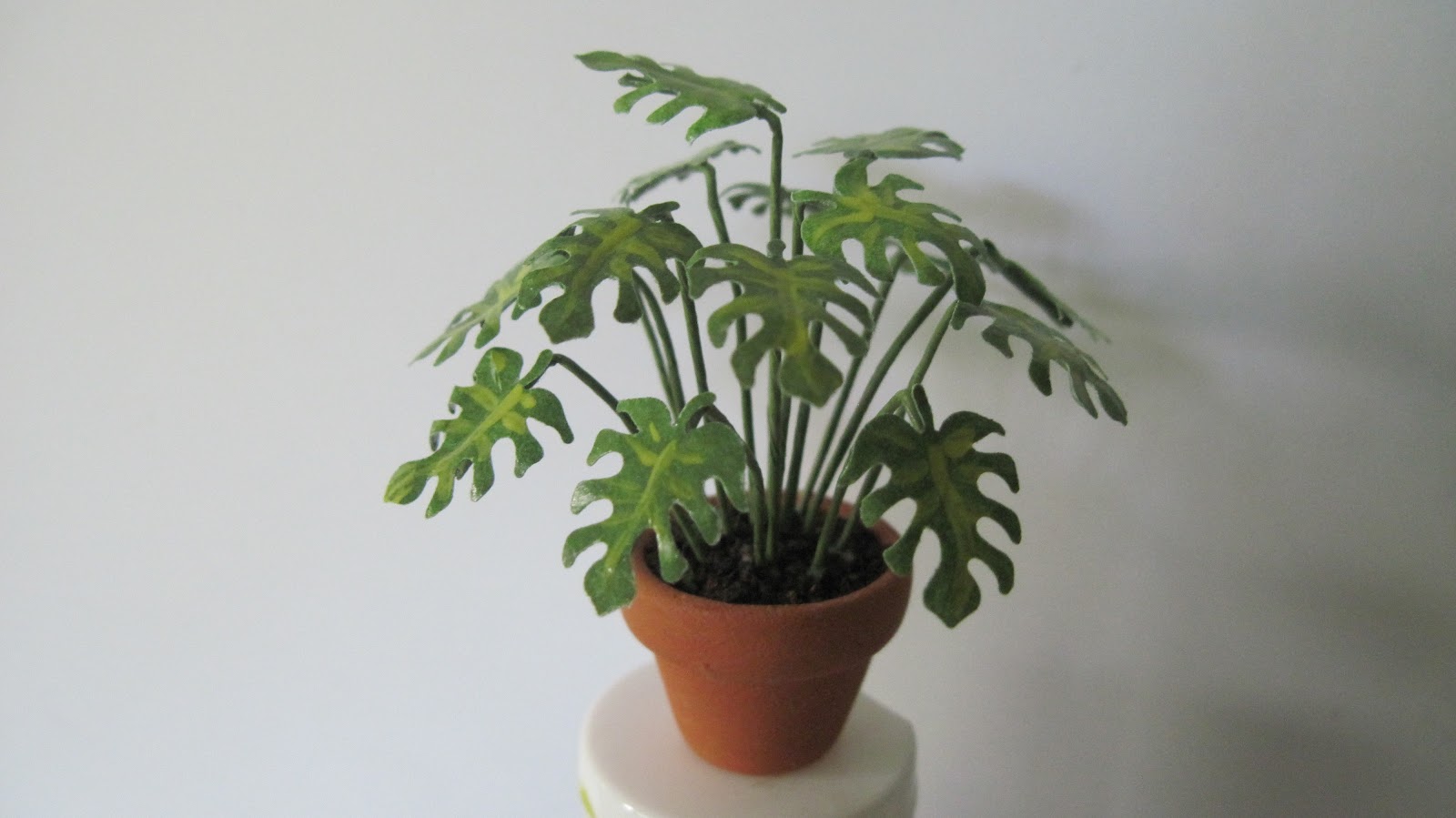
 Among the items in the things from our mutual miniature friend was a punch for split-leaf philodendron leaves, so I had to try it out, of course. But first, paper needed to be painted, as I'd gone through almost my entire stock of leaf paper. Marilyn was putting together a fuchsia kit here Friday, so I painted on the other side of the breakfast bar. 


I do like the leaf, but wish I had more than one size; the more sizes of leaf one has, the more convincing the finished plant. This one is intended to go into a planter, which has disappeared - and I'm blaming the cat, who has been batting around every tiny thing she can find! I think she may be heading into a sort of second kitten-hood, as she is 12 years old....

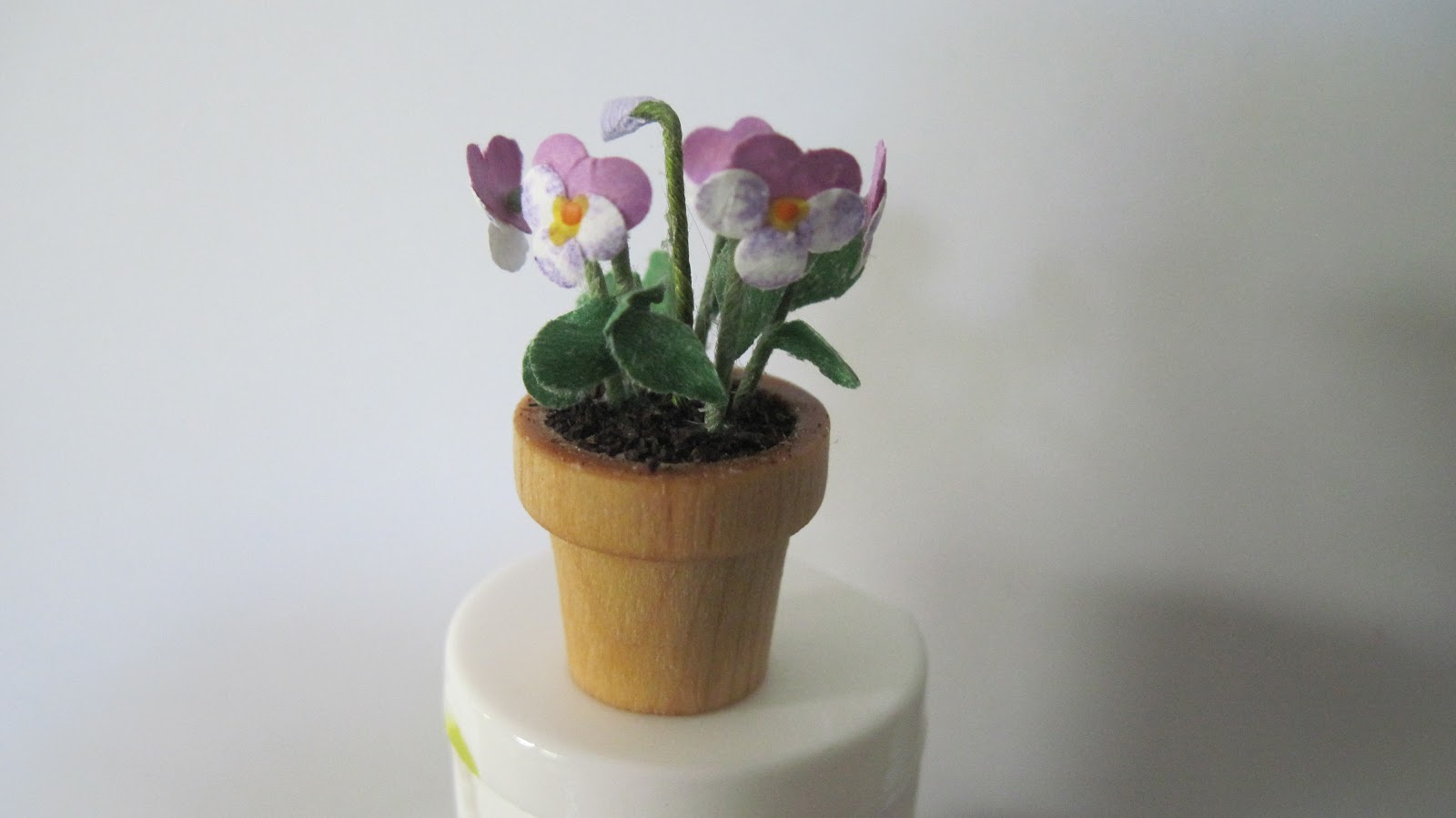
I mentioned a pansy kit; the finished product is shown below. I found I prefer my own method, and there were some things about the kit I rather didn't like. For one thing, the paper is very soft, and didn't take well to my colouring pencils. For another, the pot had plasticine stuffed into it, so the oil in that got into the wood, which will not take paint now. I did the best I could, adding a wee bead of orange paint in the centre of the yellow to add a bit of depth to the flower. (A better thing to use for "dirt" in miniature plants is something like Crayola Model Magic, an air-dry clay that takes paint and glue very well!)


There were only five pansies, so I added a bud. The kit had absolutely no room for mistakes; five heart punchies in purple, fifteen teeny white circles, ten leaves, and five 1" (2.5 m) stems. When I've taught flower making, I've always included practice punchies and longer wires, for those inevitable mistakes newbies  tend to make....

I'm still experimenting with the lily and Schefflera kits; my conclusion at this point is that I should quit while I'm still sane, and see if I can reproduce both of these very well-designed plants with some of my own paper. (I do believe I still have a Hanky-Panky lily kit that I've never assembled.) The laser-cut pieces of the lily and Schefflera are perfect, especially the lily stamens and there are some punches in my collection that I may be able to trim to the desired shapes - except for those marvellous stamens; they could only be made with a laser cutter. 

My younger daughter arrives this week for a nearly 3-week visit, and the day after she arrives, the Carpenter-in-Chief and I have to drive to Quebec City, for a funeral delayed due to Covid. We'll drive the day of the life celebration, stay overnight and head home on Saturday, and our daughter can look after that darn cat while we're gone! She will likely use my car to visit her best friend not far from here while we're away.

Thursday, 19 May 2022

Now Where Did I Put My Heart Punches?


I actually started this physalis or Chinese Lantern plant a week or more ago, but have somehow managed to lose all of my heart punches in some weird place. However, during our sorting process of a friend's stash, there was a triple heart punch the right size. Just one small problem, the actual die-cast punch part is in the plastic housing the wrong way around. This means punches have to be extracted from the works with tweezers. Things can get a little complicated, sometimes....

However, yesterday our meeting did not happen due to other things, so I decided to work on the plant. It is in a pot because, although very decorative, it is also very invasive! The original instructions came from a Jicolin Advent Calender in 2011, by Minipat, a French blogger. She used tissue paper for her flowers, which I usually replace with coffee filter paper. The backwards punch would not punch this light paper, so I decided to use computer-weight coloured paper instead. The flowers are made of a seed bead in the colour of the flower, glued to a stem. Two hearts are applied points up, and when they are dry, two half hearts are glued over the sides of the "heart sandwich".  

As my paper was stiffer, I creased each heart down the centre and then rounded out the lobes of each heart. The half hearts are also rounded out before being applied. Although not entirely successful - the seed bead shows in some places - I am pretty happy with this version of a Chinese Lantern in miniature. It would look good in miniature "dried" flower arrangements. along with lotus and milkweed pods, which I have made in polymer clay in miniature....

We miniaturists are sort of crazy....


Saturday, 25 July 2020

And That Is That

All the foliage plants are done: 

So everything has switched places again; I wonder what I did? Anyways, these are the last six.


OK, it all changed again, but I didn't do anything; this is a photo of the whole grouping. There are two of each plant, one set to keep and one set to sell or pass on....

I hope to be able to start on my klompenfabriek later this week, as our wood shipment has arrived and it contains my stairway stringers. Onwards and forwards!

Friday, 24 July 2020

More Plants, Kind of Boring?


We didn't have our usual Wednesday afternoon virtual meeting, but I worked on potting up some plants both then and today; this is the newest batch.

The coloured ones are begonia varieties, while the three green ones are maranta varieties; I'm used to the smaller prayer plants, but must admit that the the tall ones is quite new to me. There are only half a dozen or so plants left to go, except for one other pink begonia, the rest are marantas. And along with one more tall maranta, there are two pretty large ones and two huge ones.

These printies are probably the nicest ones I've ever seen. As mentioned, they are from 1 zu 12, the German magazine. This week I was gifted another copy of that, and there are half a dozen things in it that I'm just itching to put together!

Sunday, 12 July 2020

More Potted Foliage Plants


There is still at least one more pair of begonia plants to make up and pot. I hope I have enough pots! The light green plants are the first of the prayer plant (maranta) family; there are at least another dozen to go.

While the green-leaf plants look good in terra cotta pots, I planted the red ones in white pots, as there would otherwise be too much red. The remaining begonia pair is pinkish, and I have to decide what sort of pot would look good with them.

As mentioned in the previous post, these plant printies are from 1 zu 12, the German magazine. They are very good quality, and I did have them professionally printed, one of my few outside trips recently. Our scanner is not very good with European A-4 paper, and tends to cut off the edges all around.

To shape these, I first ran a ball stylus around the outside edges of the leaves, on the back. Then I flipped them over, and made a little hook-shaped crease in the centre, as one side of their leaves is smaller than the other; another name for these is elephant-ear begonias, a very good nickname! The wire stems are fine gauge, light or dark green or red, with a 90 degree hook at the top which I use to glue them down on the leaf printie.

Boutique Pulchinella continues to fill up.

Friday, 10 July 2020

Begonia Plants


I am making plants. All of the plants I am working on are foliage plants, and this first batch is begonias, all colours of them. The printies came from an issue of 1 zu 12, the German-language miniature magazine. There will, eventually, be two pots of each plant.

I have returned to half days at my volunteer job (museum accessioning), and my co-volunteer gifted me with three terra cotta pots; the green begonia is in one of them. I have never before come across pots in this size; they are in between the wooden ones I use and the terra cotta ones available at places like Michael's (North American hobby shop).

 My collection of white plastic caps will also be used in this project; in my house, most of the smaller plants are in white ceramic pots of many different shapes and sizes. There are four more begonia varities to pot up, and then there are about a dozen maranta varieties; the most common of these is known as a prayer plant. As some of those are quite small, they will go into my tiniest pots.

Toothpaste caps and the like are kind of a cliche in miniatures, but sometimes simple things are more eye-catching - in a good way - than complicated ones. And they're free....

Tuesday, 26 May 2020

A New Chrysanthemum


I wanted to make a bronze-coloured mum, and this one uses three different shades of paper; brown in the centre, ochre in the middle and golden yellow on the bottom. I also tried a different leaf; for years, I've been using the leaf on the maroon mums, but I decided to try a very small oak leaf. I really like it, it makes the plant look dainty. Opinions?


So just for the heck of it, I decided to list the number of components in a 7-bloom, 3-blossom pot of miniature chrysanthemums like these. Each bloom consists of: a stem with the end dipped in glue and paint, nine petal punch-outs, a sepal punchie, and two leaf punchies. Two of the colours were hand-painted, while the ochre came from some wide quilling paper I purchased years ago. The leaf paper is also hand-painted. Then there are three blossoms, consisting of a dipped wire, and two punchies each, as well as two leaves and a sepal. To fill the pot out, there are seven stems of three leaves each, made of hand-painted paper. Every single punch-out was hand-shaped. The total for a pot of mums? More than 200 individual pieces!

I used to sell my mums at shows for $9.00 Canadian; that may have to change!

Now I have to find the instructions for a realistic potting table: a dirt-filled bin with a sliding tray, a space for trowels and the like, and a shelf below to hold the bags of soil and fertiliser. That means going through dozens and dozens of old  DHN magazines. Although I looked for an index, I couldn't find one. Hopefully, we can have another mini day tomorrow, perhaps even meet up in person again; we can get together in groups of 10 as long as we keep our social distances....

Sunday, 24 May 2020

I'm Potty! (In the British Sense!)


Potted up the flowers today that I made in the course of the week. In the process, I caught the side of my finger in the spring mechanism of one of my plier-type punches; I didn't scream, didn't cry, just recaptured control, squeezed the handles, and freed my finger. Lots of blood, unfortunately! And the injury is very near the joint, so the bandage is interfering with my freedom of movement. The white and yellow marguerites were made with centres of model railroad flower stuff that has to predate Flower Soft. I do like the effect, which is easily visible if you click to enlarge the picture.


The dark red mums are an interesting jolt of colour; now I want to make some orange-bronze ones. But it will have to wait, as I am very consistently clumsy today. I am blaming this on the bandage.

Friday, 22 May 2020

More Flowers


We had another virtual mini meeting this afternoon, and I made some dark red chrysanthemums, which are destined for Floriana's autumn window. The paper was painted with artist's quality markers, in 3 closely related shades to give some depth to the flowers.

Yesterday, I tried a new way of making marguerites, and they turned out quite nice. However, darn it, I opened a new packet of floral wire that I think I got in the UK years ago, but the paper wrapping around the wire is very fragile! You can see it gathering like wrinkly stockings in the photo. In the future, I'll have to glue the paper when I cut the wire; that means the wire will be a bit thicker, which means it may well catch up on the holes in the flowers. Bah! Patience is really not my strong suit.

I'd like to make some deeper colour flowers for the autumn window, and may try bronzey-orange for the next pot of mums. In my Real-Life garden, the pale daffodils have come out in full glory, and the tiny pheasant eye primulas below them are looking glorious too; they have really spread, and the two patches I have currently may become four patches next year. A group of deep purple-red primroses opened in the perennial bed today; all my primulas and primroses come from the local botanical society annual sale. This year they are hoping to have an on-line sale, and I should really order a few more primroses.

Wednesday, 20 May 2020

Virtual Mini Meeting


Marilyn and I managed a virtual mini meeting today, but unfortunately Louise couldn't get herself connected. I worked on under-planting the morning glory trellis, and am quite pleased with the finished product.

If you enlarge the photo, you will see a few tiny wire tendrils here and there on the vine. The under-planting consists of preserved reindeer moss and paper leaves and flowers. The colours are meant to underscore the morning glory's colours; tiny purple lobelia, delicate green ivy leaves, and pink and white flowers.


I also finished leafing the weeping willow sapling; it still needs to be planted, root-ball and all, in a burlap bag. It took 330 leaves to finish the tree. I like it; the leaves themselves were cut from a punched piece of hand-painted paper, and the the 11 tiny leaves were each separated from their main stem, individually creased, and then applied one by one to the tree skeleton. You can enlarge this one too, for a closer look.

And that is NOT snow outside; spring has finally come, and what you are seeing is sunlight on grey gravel, somewhat over-exposed. Overnight, the birches leafed out and showed their catkins, and the apple trees are showing tiny leaves and may blossom later this week. In the flowerbeds, two different types of primulas have opened; the original, yellow-white ones and tiny vivid pink ones. The larger cultivars - primroses - have grown up and are showing their buds; other years these have bloomed under the snow, but I guess this Spring was just too much for them, as well as for us!

Sunday, 17 May 2020

Build-a-Tree


Two tree skeletons wrapped in flower tape; the weeping willow in golden yellow, the other tree in brown.


Some of the branches of the other tree have been painted brown and tea dust "bark" has been sprinkled over them; enlarge by clicking if you want to see deatils.


The whole tree has been "barked". (Usually, in lumberjack language, this means having the bark taken off; in my case, it is having the bark added.)


And in the case of the weeping willow, 165 leaves later.... This will take some time! The branches are bent out for ease of gluing the leaves on, and will be draped back into proper weeping willow shape once the leaves are on. I think there will be a minimum of 300 needed....

Saturday, 16 May 2020

Keep Going!


I'm trying to "build" a couple of very young trees; one is obviously a weeping willow, the other has not been decided yet. This is kind of an experiment; I have to make fruit trees for the Apothecary Garden, eventually, and espaliered ones at that. Making a couple of nursery saplings for Boutique Pulchinella is how I'm starting.

The last time I was in the UK, we visited Kew Gardens, and also the garden around the small palace of the Mad King (George II or III?). There were lots of things growing in that garden that I knew would go well in my Apothecary Garden, so I took many photos.

These skeletons were made with 3 long painted wires, doubled over and with the ends then twined together for the start of the trunk. The wires were then cut, separated, wound together, and other wires spliced in; the bumpier joints can be hidden behind leaves. As I have to paint and/or wind floral tape around the skeletons, I decided to give them a coat of sealer first. That has to dry overnight....

The long bench for the Klompenmakerij is finally done; I had real problems putting in the braces. Because the bench is long, it needed long braces; long braces have no 45 degree angles, which is all that I have in my mitre box. That meant carving the proper angles, free-hand. And the legs kept falling off. But I persevered!

The window and door pieces for the Klompenmakerij needed two coats of green paint; I topped that off with a coat  of satin varnish. The paint I remember from my childhood was enamel, but shiny paint does not look good on miniatures. However, the satin varnish gives just enough of a hint of shine that it worked well.

I will have to punch a couple of hundred tiny willow leaves! If this experiment works, I would like to make some fruit trees, and a couple of citrus trees in wooden planters would look very nice for the Boutique.

Sunday, 26 April 2020

Again Two in One Day


The morning glories are planted in the French planter; they need "dirt" and some under-planting, but that will be for another day. Do enlarge this picture by clicking on it, the tiny dark thing in front of the morning glories is the coral bead plant I found in the magazine mentioned in the previous post. It's in a tiny cobalt blue ceramic horn of plenty pot.

The morning glories are 1/4" (6 mm) circles, each with a magenta centre and a white, acrylic ink star in them. There are 25 or so of them on the plant; I didn't count the leaves, just filled things in until I liked the look of things. The flowers have calyxes, i.e. each one is set on a twisted piece of wire dipped in white paint. I think I am crazy, but I may add some jewelry wire tendrils and some buds.

The coral bead plant is made with a small clump of model railroad foliage, with some mixed foliage scatter over top, while the tiny beads are HO gauge(?) oranges. I found the best way to attach those was to dip the tip of a toothpick in glue, pick up an orange ball, then sort of smear that in place on the foliage clump. Not very elegant, but it worked!

Friday, 24 April 2020

Progress Report

I made a pair of New Guinea Impatiens plants today. And some sunflowers. I also painted the "stone" plinths, and started a second pot of lavender.


The plinths are made of a block of wood, with wood top and bottom, and some cereal box cardboard decorations, topped up with part of a jewelry finding.


The wall pocket has one of the sunflowers, and the others are destined for fall floral arrangements.


Tomorrow, if the energy continues, I'll finish the second batch of lavender and start on some of the other plants to go into the arrangements. Making flowers takes time....